


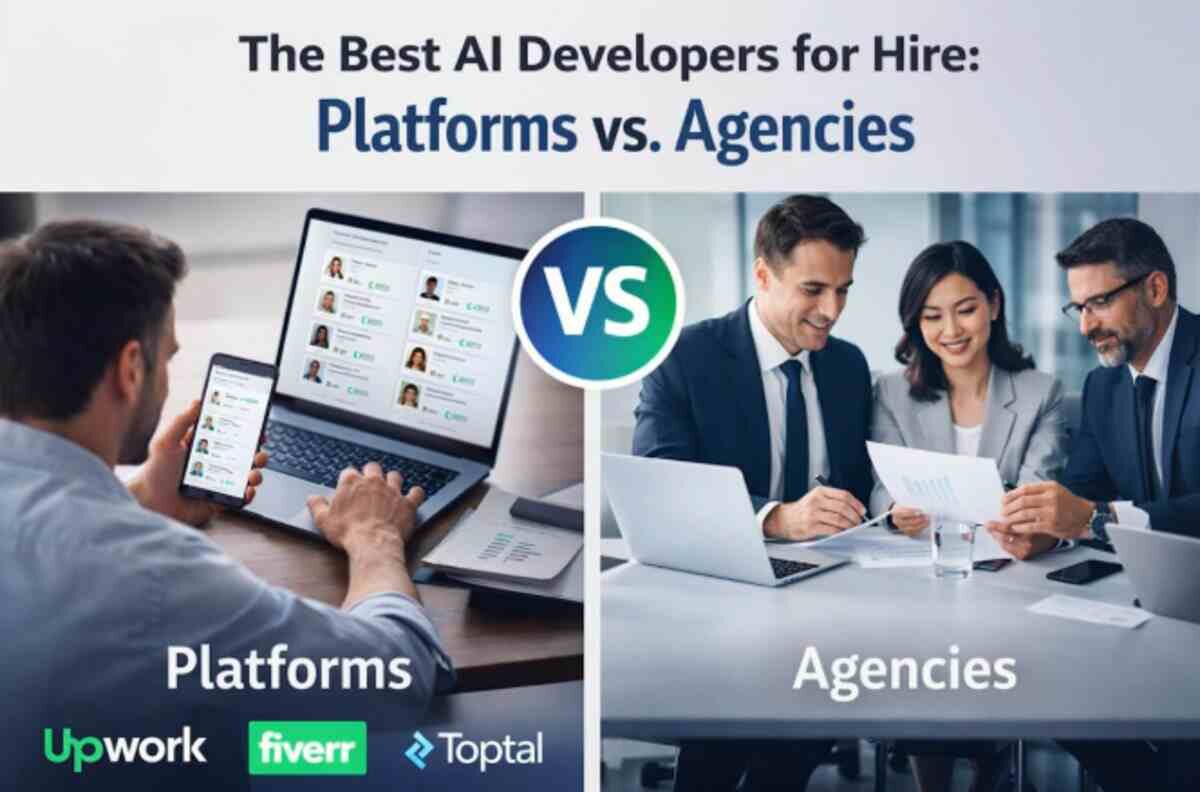
AI is in everything now—from product recommendations to internal chat systems. So, hiring the right people to build AI-driven tools has never been more important. But the hiring path isn’t always clear. Should you go straight to freelance platforms, or work with an agency?
There’s no perfect answer, but there is a smart one for your situation. Let’s talk through what each option really offers, where they fall short, and how to figure out what fits your goals.
Platforms: Flexible, Fast, but You’re in the Driver’s Seat
Let’s start with the hiring platforms—Upwork, Freelancer, Toptal, Fiverr, and a few others. You’ve probably browsed one or more of them before.
Here’s what makes them attractive: you get access to thousands of developers, often with detailed profiles, reviews, and portfolios. You can filter by skill, cost, location, and experience.
You get speed and options. But there’s a tradeoff.
Where platforms win:
- Fast access to talent: You can post a job and start getting proposals within hours. Some platforms even offer talent matching services to save time.
- You control the cost: Hourly rates range from budget-friendly to premium. It’s up to you to decide what you’re willing to pay and who fits the bill.
- You can test ideas without big investments: Want to build a quick prototype or test a concept? Hiring a freelancer for a short-term job makes sense.
- Global reach: You’re not limited to your time zone or region. You might find someone in another country who’s a perfect match for your project.
And where platforms can frustrate you:
- You do all the screening: Even when someone looks great on paper, there’s no guarantee they’ll deliver. You need to ask the right questions, check their work, and manage them closely.
- Quality can be hit or miss: Just because a developer knows TensorFlow or PyTorch doesn’t mean they’ve used it for your kind of project. Some only know how to follow tutorials. Others are brilliant. You won’t know until you dig deeper.
- Communication isn’t always smooth: Language barriers, different time zones, and varying communication styles can slow things down. You’ll need patience and structure to make it work.
- You manage the project: Freelancers won’t manage scope or timelines. That’s your job unless you hire someone with PM experience, which can drive up cost.
So when should you use platforms? If you’re on a tighter budget, need quick turnaround, or want to experiment with ideas, platforms make sense. Just be ready to get your hands dirty with interviews, trial tasks, and constant follow-ups.
Agencies: All-in-One Teams, But With Structure and Cost
Agencies are a totally different approach. Instead of hiring one person, you’re bringing in a team that’s been working together, has its own systems, and takes care of most of the heavy lifting.
Some focus entirely on AI development. Others are broader tech firms with AI teams on board.
Why agencies are worth looking at:
- You’re buying experience: A good agency has been through enough projects to know what works and what doesn’t. They can guide decisions, offer options, and help you avoid common mistakes.
- You don’t need to micromanage: They’ll assign a project manager or tech lead who handles progress, communication, and updates. You just focus on results.
- They come with process: Documentation, version control, QA testing, backups—agencies tend to run more organized projects.
- Scalability is built-in: Need 2 developers now but 6 later? Agencies can usually ramp up without starting from scratch. That’s a big plus if your needs grow.
- Long-term support: Agencies offer ongoing maintenance, updates, and feature additions. You don’t need to rehire for every small tweak.
But let’s be honest, there are tradeoffs:
- Higher upfront costs: You’ll pay more. Sometimes a lot more. You’re not just covering developer hours—you’re paying for project management, QA, planning, and overhead.
- Contracts and timelines are stricter: Agencies will scope out the project, define timelines, and stick to them. It gives clarity but also limits flexibility if your ideas shift mid-project.
- Less control: You’re not picking each individual developer. You’re trusting the agency to assign the right people. Some business owners love this. Others don’t.
So when should you go with an agency? If your project is complex, has long-term goals, or impacts critical parts of your business, an agency gives you the stability and structure to make it work smoothly.
So, Which One Should You Choose?
It comes down to what you really need.
Ask yourself:
- Do I have the time and skill to manage a developer directly?
- Is this a short-term job or a bigger commitment?
- How important is flexibility versus reliability?
- Do I need strategic input or just someone to follow instructions?
If you’re still figuring things out, testing ideas, or working on a limited budget, platforms give you more freedom. If you’re serious about launching a product, serving users at scale, or integrating AI into your core systems, an agency might save you time and stress.
Tips for Hiring AI Talent That Doesn’t Disappoint
No matter where you hire, getting it right starts with asking better questions. Don’t stop at “Do you know Python?” or “Have you worked with AI?”
Try these instead:
- What’s the most complex AI system you’ve built?
- Can you walk me through the workflow and decisions?
- What tradeoffs did you make, and why?
- How did you handle testing and accuracy?
- How would you approach our specific use case?
The answers will tell you way more than a polished resume ever could.
And while you’re at it, consider this: when you hire AI developers, it’s not just about code. You need someone who gets the business context, knows how to work with data (or knows when it’s garbage), and can actually turn your idea into something useful.
It’s easy to find people who say they can build AI. It’s harder to find someone who can build it in a way that’s practical, scalable, and fits your real-world needs.
Think Tools, Not Just Skills
If you’re in the early stages of recruitment or building internal HR tools, you might be looking into options like an AI Interview Tool. These tools help automate screening, filter resumes, and assess candidates through recorded video interviews or chat-based assessments.
Hiring developers who’ve built or worked on this kind of software can give your project a serious edge. They’ll understand not just the tech but how people actually use it.
This is where AI and automation start to overlap. It’s not about building something fancy—it’s about reducing manual steps, saving time, and improving outcomes.
So if your product or service involves process automation, don’t just look for an “AI expert.” Look for someone who’s already worked on projects where AI helped cut down repetitive tasks or made decision-making easier.
That kind of experience matters way more than buzzwords on a profile.
Key Takeaway: You’ve Got Options, But Know What You’re Signing Up For
Both paths—platforms and agencies—can lead to success. But they each come with a different kind of commitment.
If you want speed and budget control and are ready to stay involved in the project daily, platforms are a solid choice. You’ll have to do more upfront work, but you’ll also have more flexibility.
If you want something managed, more strategic, and long-term, agencies will take the pressure off and bring structure to the process.
And don’t forget to focus on what the developer or team has actually built—not just what they claim they can do.
Whether you’re building internal tools, customer-facing products, or something entirely new, the right hire makes all the difference.
